
Recent Comments


Does Your Pastor Practice Oikonomia?
Over at Internet Monk, Father Ernesto has written a brief introduction to oikonomia, a prominent feature of pastoral care in the Orthodox tradition. It basically boils down to dealing with people as if the goal were not to “fix” them but to bring them to God:
Americans have a strong built in idea that God is a law and order God. There is only one problem. That is not really what God seems to do in Scripture. He does support principles of justice. The prophets constantly rail against injustice. But, God’s purpose is to bring people into his kingdom. And, if a law appears to interfere with bringing someone into the Kingdom of God, then God has no problem in putting that law aside. Thus, the woman caught in adultery is forgiven outside the law because that unexpected forgiveness is precisely what she needs to hear in order to bring her into the Kingdom of God.
It should be noted, however, that although oikonomia can involve lessening the prescribed penance for sin, it could in some circumstances mean a hard-hearted (or headed) sinner might require a more severe penance in order to bring him to his senses. The bottom line is to deal with each personal individually rather than blindly applying the canons:
God understands people and God understands what will best work to give the best possibility that a person will truly come to him and be saved. In the same way, the bishop and his priests and deacons are called not to simply apply the canon, but to so come to know the person involved that when they apply the canon, they will do so in the way that is most likely to preserve that person’s salvation. Thus someone may be ordained much sooner than expected. A discipline for a sin committed by a church member may either be lightened or strengthened. But, at bottom, whatever action is taken must be based on a knowledge of a person and what will most help their journey to salvation.
So, oikonomia involves fulling admitting that rules and structure can be positive—and that there is such a thing as sin—but being willing to address these matters as if there were something more important than written laws and guidelines. It almost sounds like something Jesus would do, doesn’t it? 🙂
Uncanny Georgia: Chief-of-Deer
As Bill Grantham tells us,
Chief-of-Deer was described as a small deer about two feet high that was either speckled or white with lofty horns. Lena, however, described it as only about two or three inches tall and relates the belief that anyone lucky enough to see a male would have the gift of learning sacred formulas easily. (Creation Myths and Legends of the Creek Indians [University Press of Florida, 2002] 36)
This mysterious creature has a counterpart in Cherokee folklore named Awi Usdi or “The Little Deer.” In ancient times, Awi Usdi advocated for deer-kind with humans by appearing to them in their dreams, urging them only to hunt as much game as they needed to survive and to perform certain hunting ceremonies to acknowledge their indebtedness to the deer for its meat and even ask its forgiveness.
When hunters were careless and did not perform the required rituals, Awi Usdi used his magic to afflict them with rheumatism.
Uncanny Georgia: Atsil-dihyegi
Here is one more Cherokee myth, as reported by James Mooney:
Hermann Hendrich, Will-o’-the-wisp and Snake
There is one spirit that goes about at night with a light. The Cherokee call it Atsil’-dihye’gï, “The Fire-carrier,” and they are all afraid of it, because they think it dangerous, although they do not know much about it. They do not even know exactly what it looks like, because they are afraid to stop when they see it. It may be a witch instead of a spirit. Wafford’s mother saw the “Fire-carrier” once when she was a young woman, as she was coming home at night from a trading post in South Carolina. It seemed to be following her from behind, and. she was frightened and whipped up her horse until she got away from it and never saw it again. (Myths of the Cherokee [1900] 235)
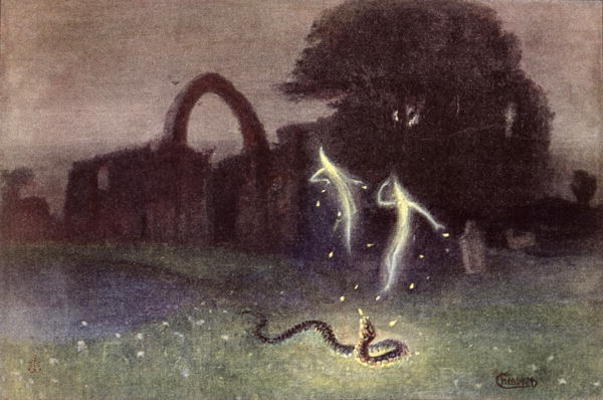
This sounds like a will-o’-the-wisp or ignis fatuus, a phenomenon known—and mythologized—in many cultures of the world. This version seems to provoke a bit more terror than most, however. There may be more here than meets the eye.
Sunday Inspiration: Home
There’s no place like home.
—L. Frank Baum
So Apparently They Spotted a Bigfoot in North Carolina
Have no fear, though. The guy says his Yorkie protected him.
Uncanny Georgia: Long Ears

Wikimedia user: Dmitry Bogdanov / GFDL
Bill Grantham describes a curious creature called “long ears” or hvcko cvpko (roughly pronounced hutch-ko chupp-ko):
Long Ears was about the size of a mule, with immense ears, a very hideous appearance, and a disagreeable odor; it caused a dangerous disease. Two colors of this creature are described: dark brown, and nearly black and slate color. The Oklahoma Seminoles described the being as gray, about three feet tall, with a head like that of a wolf, the tail of a horse, and enormous long ears. Like Tall Man [i.e., a giant], it was said to smell like stagnant muddy water. (Creation Myths of the Creek Indians [University Press of Florida, 2002] 36)
The wolfish head and comparisons with a horse or a mule lead me to wonder if perhaps some species of mesonychid (like the Sinoplotherium pictured above, but with long ears?) would be an appropriate stand-in for this creature, should it ever find its way into fiction.
Review of Wandering Djinn
Here is my review of Wandering Djinn: An Anthology of Fantasy by Ahmed Al-Sheikh:
As the subtitle states, this is an anthology. The stories are loosely connected, but all involve Malik, a djinn who wanders the earth trying to do good and protect mortals from supernatural danger. I think this is a great concept for a story, but the execution is a bit uneven. At times, the author “tells” rather than “shows.” On other occasions, the point-of-view character shifts abruptly—at least once over the course of a single paragraph. Still, the author doesn’t burden these stories with an undue amount of background information. The worldbuilding is there, but usually subtle and unobtrusive.

Given the nature of this website, I would add that there are a couple of fairly gruesome scenes that would not be suitable for younger readers. It was, however, a halfway decent story. It’s currently available for free, and it might be something some of my readers are interested in.
If you’d like to learn more about the djinn (or jinn) of Arabic legend, I’ve got a post (or two) that might help you with that.
Uncanny Georgia: The Istipapa
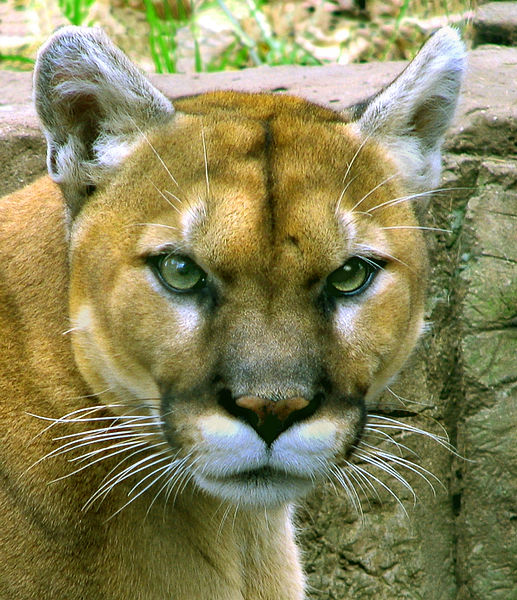 The istipapa (este papv in standardized spelling) or “man-eater” is a fierce creature from the mythology of several Native American nations of the Southeast. Though some groups conceived of the istipapa as bear-like, the Creeks and Seminoles though of it as a huge feline, something like a giant mountain lion. (Its name is, in fact, sometimes translated as “lion.”) As its name suggests, it has been known to devour not only livestock but also human beings.
Michelle Smith recounts the following Creek legend in Legends, Lore and True Tales of the Chattahoochee (The History Press, 2013):
One of the more famous stories of the Isti-PaPa states that one particular cat plagued a Creek tribe. Members of the tribe tried to kill it by digging a pit and covering it with a net made of bark. Then they lured it out of its cave by throwing in a rattlesnake. The beast rushed forward with more anger and chased them through the branches. The tribe decided it was better for one to die than all, so the members took a motherless child and threw him before the lion as it came near the pit. The lion rushed at the child and fell into the pit; tribe members jabbed at it with blazing pinewood and killed it. After killing the Isti-PaPa, they took its bones and laid them on either side of the pit. They tarried there seven days because the creature would come every seventh day to terrorize them. In remembrance of the Isti-PaPa, the tribe would fast for six days and begin war on the seventh. If warriors took his bones with them into war, they would have good fortune.
Colin Farrell and Fantastic Beasts
Via Entertainment Weekly:
Colin Farrell is the latest Muggle to join the cast of the upcoming Harry Potter spin-off Fantastic Beasts and Where to Find Them, EW has confirmed.
The actor, currently starring in the second season of HBO’s True Detective, will join Eddie Redmayne, Katherine Waterston, Ezra Miller, and Alison Sudol. According to the original report by The Hollywood Reporter, Farrell will play a wizard who encounters Newt Scamander (Redmayne) during his journey to study magical creatures in America.
The film, which is currently slated for a December 2016 release, will also boast a cadre of Harry Potter alums behind the camera, including director David Yates, producer David Heyman, and first-time screenwriter J.K. Rowling.
I’d still love to see some authentic North American fantastic beasts when this movie finally comes out. We’ll just have to wait and see…
 Darrell J. Pursiful