
Recent Comments


Uncanny Georgia: The Atcukliba
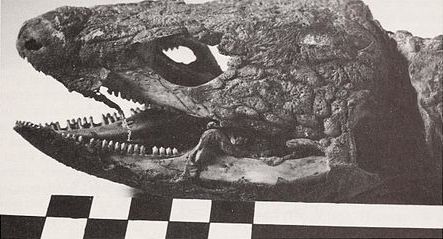 Here’s one last creature from Bill Grantham’s Creation Myths and Legends of the Creek Indians (University Press of Florida, 2002):
There was also a monster lizard that lived in hollow trees like a bear and was called Atcukliba, which was the same name used to refer to a “small, inoffensive striped lizard” found on trees. (37)
In standardized spelling, this would be vcoklepv (pronounced roughly uh-choo-glee-buh). If you’re walking in the woods and your Creek hiking partner says he sees an atcukliba, it would be a good idea to clarify whether he’s talking about the “small, inoffensive” kind or the “monster” kind. It might be important.
Tolkien’s Kullervo to Be Published
Via PBS:
A 1914 manuscript that formed the early basis for J.R.R. Tolkien’s works of epic fantasy will be widely published for the first time this summer.
“The Story of Kullervo,” which Tolkien wrote while at Oxford University, has previously only been published in the journal “Tolkien Studies: Volume 7.” It will be widely distributed for the first time in the U.K. on Aug. 27 and in the U.S. on Oct. 27.
The book follows the story of an orphan seeking revenge on the dark magician who killed his father. Tolkien based the book on the Finnish epic poem “The Kalevala,” which was published in English for the first time in 1888.
Uncanny Georgia: Daughters of the Sun
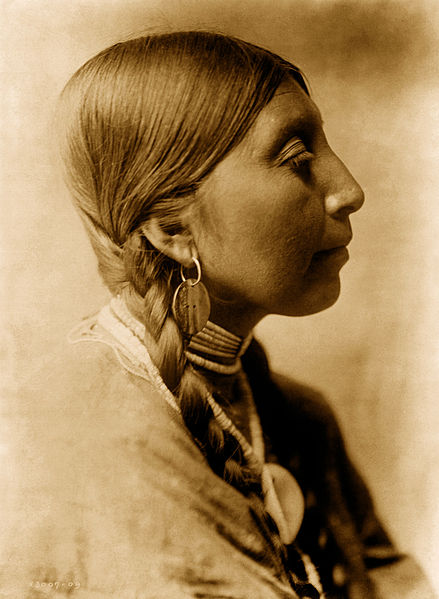 Here’s a fun one. According to a legend from southern Georgia, a Creek hunting party once got lost in the Okefenokee Swamp. At the height of their desperation, they were rescued by a group of beautiful women. According to an early 19th-century report:
[They] being lost in inextricable swamps and bogs and on the point of perishing, were unexpectedly relived by a company of beautiful women, whom they call daughters of the Sun, who kindly gave them such provisions as they had with them, consisting of fruit and corn cakes. (Jedidiah Morse, The American Universal Geography [J. T. Buckingham, 1805] 726)
Having rescued, cared for, and fed their guests, the women then warn them to flee as fast as possible “because their husbands were fierce men and cruel to strangers” (Morse, 726). These husbands were said to be of gigantic stature. They are hairy, aggressive, barely civilized wild men.
For their part, however, the “daughters of the sun” are beautiful nymph-like beings with dark eyes and musical voices. They often appear in thin, clouded forms, and have been compared to angels.
Despite their brutish husbands, the daughters of the sun dwell in an inaccessible island paradise. Morse continues to describe their settlements,
situated on the elevated banks of an island, in a beautiful lake; but that in their endeavours to approach it they were involved in perpetual labyrinths, and, like enchanted land, still as they imagined they had just gained it, it seemed to fly before them.… When [the hunters] reported their adventures to their countrymen, the young warriors were inflamed with an irresistible desire to invade and conquer so charming a country, but all their attempts had hitherto proved fruitless, they never being able again to find the spot. (726–27)
The idea of beautiful, helpful women married to terrible ogres seems to be an almost universal trope in fairy tales. This is but another variation on that theme.
Does Your Pastor Practice Oikonomia?
Over at Internet Monk, Father Ernesto has written a brief introduction to oikonomia, a prominent feature of pastoral care in the Orthodox tradition. It basically boils down to dealing with people as if the goal were not to “fix” them but to bring them to God:
Americans have a strong built in idea that God is a law and order God. There is only one problem. That is not really what God seems to do in Scripture. He does support principles of justice. The prophets constantly rail against injustice. But, God’s purpose is to bring people into his kingdom. And, if a law appears to interfere with bringing someone into the Kingdom of God, then God has no problem in putting that law aside. Thus, the woman caught in adultery is forgiven outside the law because that unexpected forgiveness is precisely what she needs to hear in order to bring her into the Kingdom of God.
It should be noted, however, that although oikonomia can involve lessening the prescribed penance for sin, it could in some circumstances mean a hard-hearted (or headed) sinner might require a more severe penance in order to bring him to his senses. The bottom line is to deal with each personal individually rather than blindly applying the canons:
God understands people and God understands what will best work to give the best possibility that a person will truly come to him and be saved. In the same way, the bishop and his priests and deacons are called not to simply apply the canon, but to so come to know the person involved that when they apply the canon, they will do so in the way that is most likely to preserve that person’s salvation. Thus someone may be ordained much sooner than expected. A discipline for a sin committed by a church member may either be lightened or strengthened. But, at bottom, whatever action is taken must be based on a knowledge of a person and what will most help their journey to salvation.
So, oikonomia involves fulling admitting that rules and structure can be positive—and that there is such a thing as sin—but being willing to address these matters as if there were something more important than written laws and guidelines. It almost sounds like something Jesus would do, doesn’t it? 🙂
Uncanny Georgia: Chief-of-Deer
As Bill Grantham tells us,
Chief-of-Deer was described as a small deer about two feet high that was either speckled or white with lofty horns. Lena, however, described it as only about two or three inches tall and relates the belief that anyone lucky enough to see a male would have the gift of learning sacred formulas easily. (Creation Myths and Legends of the Creek Indians [University Press of Florida, 2002] 36)
This mysterious creature has a counterpart in Cherokee folklore named Awi Usdi or “The Little Deer.” In ancient times, Awi Usdi advocated for deer-kind with humans by appearing to them in their dreams, urging them only to hunt as much game as they needed to survive and to perform certain hunting ceremonies to acknowledge their indebtedness to the deer for its meat and even ask its forgiveness.
When hunters were careless and did not perform the required rituals, Awi Usdi used his magic to afflict them with rheumatism.
Uncanny Georgia: Atsil-dihyegi
Here is one more Cherokee myth, as reported by James Mooney:
Hermann Hendrich, Will-o’-the-wisp and Snake
There is one spirit that goes about at night with a light. The Cherokee call it Atsil’-dihye’gï, “The Fire-carrier,” and they are all afraid of it, because they think it dangerous, although they do not know much about it. They do not even know exactly what it looks like, because they are afraid to stop when they see it. It may be a witch instead of a spirit. Wafford’s mother saw the “Fire-carrier” once when she was a young woman, as she was coming home at night from a trading post in South Carolina. It seemed to be following her from behind, and. she was frightened and whipped up her horse until she got away from it and never saw it again. (Myths of the Cherokee [1900] 235)
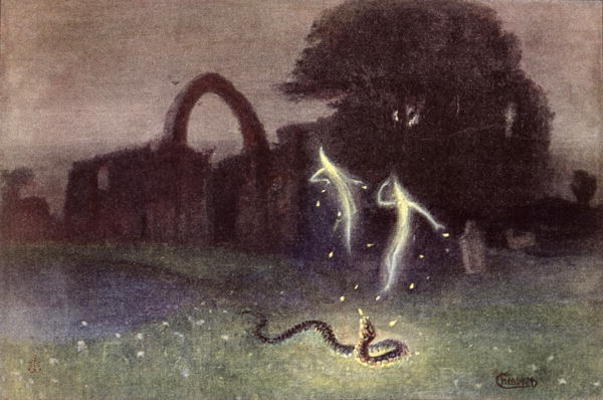
This sounds like a will-o’-the-wisp or ignis fatuus, a phenomenon known—and mythologized—in many cultures of the world. This version seems to provoke a bit more terror than most, however. There may be more here than meets the eye.
Sunday Inspiration: Home
There’s no place like home.
—L. Frank Baum
So Apparently They Spotted a Bigfoot in North Carolina
Have no fear, though. The guy says his Yorkie protected him.
Uncanny Georgia: Long Ears

Wikimedia user: Dmitry Bogdanov / GFDL
Bill Grantham describes a curious creature called “long ears” or hvcko cvpko (roughly pronounced hutch-ko chupp-ko):
Long Ears was about the size of a mule, with immense ears, a very hideous appearance, and a disagreeable odor; it caused a dangerous disease. Two colors of this creature are described: dark brown, and nearly black and slate color. The Oklahoma Seminoles described the being as gray, about three feet tall, with a head like that of a wolf, the tail of a horse, and enormous long ears. Like Tall Man [i.e., a giant], it was said to smell like stagnant muddy water. (Creation Myths of the Creek Indians [University Press of Florida, 2002] 36)
The wolfish head and comparisons with a horse or a mule lead me to wonder if perhaps some species of mesonychid (like the Sinoplotherium pictured above, but with long ears?) would be an appropriate stand-in for this creature, should it ever find its way into fiction.

