
Recent Comments


Review of Wandering Djinn
Here is my review of Wandering Djinn: An Anthology of Fantasy by Ahmed Al-Sheikh:
As the subtitle states, this is an anthology. The stories are loosely connected, but all involve Malik, a djinn who wanders the earth trying to do good and protect mortals from supernatural danger. I think this is a great concept for a story, but the execution is a bit uneven. At times, the author “tells” rather than “shows.” On other occasions, the point-of-view character shifts abruptly—at least once over the course of a single paragraph. Still, the author doesn’t burden these stories with an undue amount of background information. The worldbuilding is there, but usually subtle and unobtrusive.

Given the nature of this website, I would add that there are a couple of fairly gruesome scenes that would not be suitable for younger readers. It was, however, a halfway decent story. It’s currently available for free, and it might be something some of my readers are interested in.
If you’d like to learn more about the djinn (or jinn) of Arabic legend, I’ve got a post (or two) that might help you with that.
Uncanny Georgia: The Istipapa
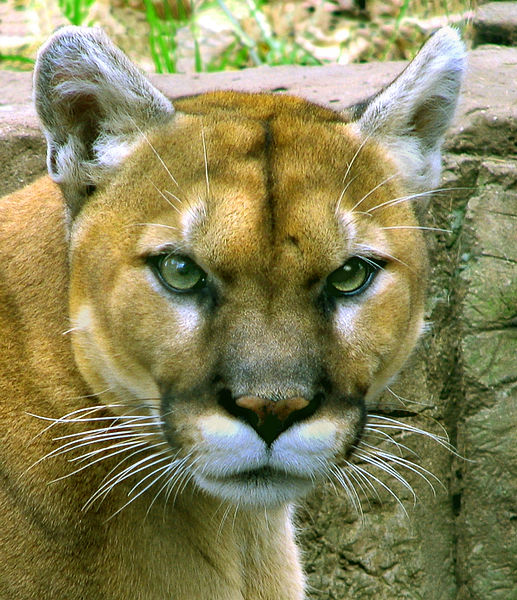 The istipapa (este papv in standardized spelling) or “man-eater” is a fierce creature from the mythology of several Native American nations of the Southeast. Though some groups conceived of the istipapa as bear-like, the Creeks and Seminoles though of it as a huge feline, something like a giant mountain lion. (Its name is, in fact, sometimes translated as “lion.”) As its name suggests, it has been known to devour not only livestock but also human beings.
Michelle Smith recounts the following Creek legend in Legends, Lore and True Tales of the Chattahoochee (The History Press, 2013):
One of the more famous stories of the Isti-PaPa states that one particular cat plagued a Creek tribe. Members of the tribe tried to kill it by digging a pit and covering it with a net made of bark. Then they lured it out of its cave by throwing in a rattlesnake. The beast rushed forward with more anger and chased them through the branches. The tribe decided it was better for one to die than all, so the members took a motherless child and threw him before the lion as it came near the pit. The lion rushed at the child and fell into the pit; tribe members jabbed at it with blazing pinewood and killed it. After killing the Isti-PaPa, they took its bones and laid them on either side of the pit. They tarried there seven days because the creature would come every seventh day to terrorize them. In remembrance of the Isti-PaPa, the tribe would fast for six days and begin war on the seventh. If warriors took his bones with them into war, they would have good fortune.
Colin Farrell and Fantastic Beasts
Via Entertainment Weekly:
Colin Farrell is the latest Muggle to join the cast of the upcoming Harry Potter spin-off Fantastic Beasts and Where to Find Them, EW has confirmed.
The actor, currently starring in the second season of HBO’s True Detective, will join Eddie Redmayne, Katherine Waterston, Ezra Miller, and Alison Sudol. According to the original report by The Hollywood Reporter, Farrell will play a wizard who encounters Newt Scamander (Redmayne) during his journey to study magical creatures in America.
The film, which is currently slated for a December 2016 release, will also boast a cadre of Harry Potter alums behind the camera, including director David Yates, producer David Heyman, and first-time screenwriter J.K. Rowling.
I’d still love to see some authentic North American fantastic beasts when this movie finally comes out. We’ll just have to wait and see…
Uncanny Georgia: Like-a-Cow
 Here’s another one from Bill Grantham: the wak omo or “like-a-cow.”
Like-a-Cow was piebald. Several traveled together, moving in a single file and alternately. One moved for a distance and stopped, then moved again. The one behind then moved up. According to Lena, Like-a-Cow was a type of bird, its name referring to its similarity to a cowbird. It was described as the most dangerous of all birds and was believed even to attack and kill wolves. (Creation Myths and Legends of the Creek Indians [University Press of Florida, 2002] 36)
I like that, even though this creature is called “like a cow,” it is actually a bird. That’s a great way to throw people off the trail, isn’t it?
In case you’re interested (I was), a cowbird is a member of the genus Molothrus, a group of birds that usually feed on insects—especially the great swarms that may be stirred up by cattle—rather than wolves. Like the cuckoo, to which they are not related, they will lay their eggs in the nests of other birds.
Heresy Discovered in Early Christianity
…Which is good news for the orthodox. Larry Hurtado explains:
I continue to see some scholars stating as unquestioned fact that “orthodoxy” and “heresy” really only emerged after Constantine, that only with the power of imperial coercion could these categories operate, and that in the pre-Constantinian period all we have is Christian diversity, with no recognizable direction or shape to it. In some cases, scholars will admit that with Irenaeus (late second century) and perhaps even Justin (mid-second century) we may see the early expressions of notions of “heresy.” But a recent study by Robert M. Royalty, Jr., The Origin of Heresy: A History of Discourse in Second Temple Judaism and Early Christianity (London/New York: Routledge, 2013), marshals effectively evidence and argument that should correct such views.
Uncanny Georgia: The Water Master
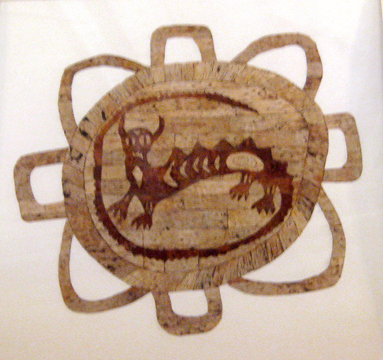 The Creek peoples speak of a creature called the Water Master or ue pucase (roughly prounounced oy poo-chah-see).
There is a bit of a debate, though, about what sort of creature this is. Some say ue pucase is just another term for the tie snake. Others, apparently among the eastern Creeks, say it is an aquatic feline creature, perhaps similar to the underwater panther of Algonquian lore.
Water Masters are cunning and deceitful creatures. According to one Hitchiti legend,
[T]he Water Master never tells the truth. The Water Master only tells half the truth and if the Water Master tells you the whole truth there is always a catch. (Bill Grantham, Creation Myths and Legends of the Creek Indians [University Press of Florida, 2002] 273)
New Lizard Man Sighting
From Bishopville, South Carolina:
The fabled Bishopville swamp creature known as Lizard Man appears to have surfaced again Sunday afternoon.
Sarah, a Sumter woman who says she went to church with a friend Sunday morning, stepped out of the sanctuary to see the Lizard Man running along the tree line.
So she did what anyone else would do — took a picture with her phone.
“My hand to God, I am not making this up,” she wrote in an email to the ABC News 4 newsroom. “So excited!”
She says they were just a mile or so from Scape Ore Swamp, the site of a similar spotting of what may also be the Lizard Man in May.
A man who asked not to be identified submitted a short video of what he thought was the Lizard Man Monday morning. He said he took the video in May while coon hunting but kept its existence quiet — until he saw the reports of Lizard Man outside a church.
Which leads me to wonder, is the Lizard Man a Baptist or a Methodist?
Uncanny Georgia: Miscellaneous Water Beings
In Bill Grantham’s Creation Myths and Legends of the Creek Indians (University Press of Florida, 2002), he cites John R. Swanton to the effect that various sorts of aquatic creatures are found in Muskogee mythology:
Swanton mentions, with little description, several water beings. Among these are the water bear, water calf, water bison, water tiger, and water person. The last of these, the water person, was described as about four feet tall and having long hair. Also mentioned by Swanton with little description are Wiofû’tc miko (water king deer), which caused certain diseases, and a Spirit of War that appears to have been in human form.
Sunday Inspiration: Magic
Above all, watch with glittering eyes the whole world around you, because the greatest secrets are always hidden in the most unlikely places. Those who don’t believe in magic will never find it.
—Roald Dahl
Uncanny Georgia: Tie Snakes
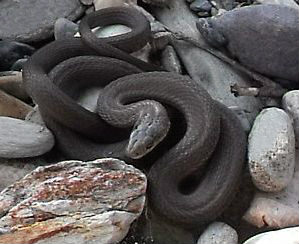 In some Muskogee accounts, “tie snake” is basically synonymous with “horned serpent.” In other versions of the myth, they are two separate creatures, of which the tie snake properly so called is much smaller than the horned serpent, and not quite as malevolent.
Tie snakes are most often associated with Muskogee culture, but they are also known, for example, to the Hitchiti, Yuchi, Natchez, and Chickasaw. In the Muskogee language, they are called estakwvnayv (ee-stah-kwuh-nah-yuh). In outward appearance, they aren’t terribly different from any ordinary snake. They are usually either black or dark blue in color. In some legends, their head is crooked over like the beak of a hawk.
But appearances can be deceiving. Tie snakes are almost always depicted as immensely strong. They often drag humans underwater, so be careful when you go near the water!
Tie snakes also exert control over water. One account has a tie snake summoning a flood large enough to overwhelm an entire town. Furthermore, these creatures are often shape-shifters. By some accounts, the tie snake was originally a man who was transformed into a serpent-like being after eating taboo food.
The most powerful tie snakes are expert animal charmers, able to command ordinary snakes to do their bidding. The “king of the tie snakes” is an almost godlike underworld being who claims to know “all things that are under the earth.” This figure might be depicted seated on a throne made of writhing snakes. He can be both frightening and demanding, but also willing to assist those who are worthy.

