
Recent Comments


Uncanny Georgia: The Ghosts of Fayetteville
 I’m not a big fan of ghost stories, but I thought I’d include at least one on my tour of “uncanny Georgia.” This one has to do with the Woolsey Road Bridge in Fayetteville, which is just south of Atlanta. According to StrangeUSA.com,
In the early 1920’s the sheriff of Woolsey, use to kill black people and he would dump there bodies into the swamp by his house. It is said if you park by the bridge and walk to the edge of the swamp that you can see the ghost of the people that were killed carrying lanterns through the swamp.
Like many ghost stories, this one involves the spirits of murder victims continuing to haunt the place where they were killed and/or buried. As brief as it is, I think this story intrigues me because there is more than one type of “ghost” to contend with: there are the ghosts of those who were murdered and there are also the “ghosts of the past”—the history of hatred and racially-motivated violence—that the story forces hearers to deal with.
Uncanny Georgia: Pterosaurs
 Yes, pterosaurs. Apparently, there have been several sightings of large flying creatures in north Georgia that strongly resemble pterosaurs, prehistoric flying reptiles believed extinct for 65 million years.
Sightings have been recorded in Waltonville/Gwinnett Counties (Loganville), Barrow County (Winder), Heard County (Franklin), and Towns County. According to one eyewitness,
[In] July of 2010, My wife and I were sitting outside when motion from above the tree tops to our left caught my attention; it’s very hard to explain how I felt at that moment. We were looking at two extremely large birds flying together and heading north . . . I can only guess to be 15-20′ wing spans and the motion of their wings as they flew was very slow. The head was long and ended in a point; wings ended in a point and appeared to be featherless . . .
Anyway, it happened again yesterday [Dec 9, 2012], this time there were three of us who saw this bird fly over, in plain sight, in daylight, up close . . .
. . . I have been trying to contact a whole lot of people (with not much success) I don’t know how to say this any other way except that I have seen these very large birds that don’t even come close to looking like anything else I’ve ever seen. I believe them to be Pterosaurs or something similar to them. . . . I have seen three of these birds in the past year and a half, I have also heard them. . . .
This last sighting has sparked me to do something about it. There were two other people with me when I saw the last one; this was three days ago. I am intent on identifying these large birds. This is not a joke, I, we have seen something that is not supposed to be here! (emphasis added)
Other accounts (linked under “Sightings” above) report the presence of a long tail on at least some of these creatures.
Sunday Inspiration: Brilliance
Sometimes, the most brilliant and intelligent minds do not shine in standardized tests because they do not have standardized minds.
—Diane Ravitch
Uncanny Georgia: The Wog
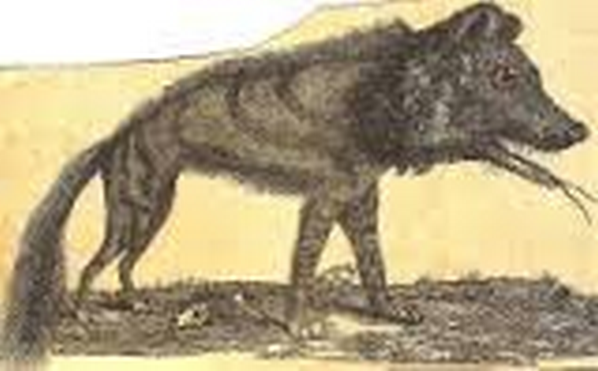 The wog, sometimes called the Georgia wog, is a fearsome beast associated with Jackson County. Think of it as a kind of black, demonic dog with characteristics of other animals as well.
G. J. N. Wilson described it, based on the accounts of early settlers, in his The Early History of Jackson County, Georgia (1914). He writes,
The wog was said to be a jet-black, long-haired animal about the size of a small horse, but his legs were much shorter, the front ones being some twelve inches longer than the hind ones. This gave him something of the appearance of a huge dog “sitting on its tail,” and when walking seemed to require him to carry forward one side at a time. His tail was very large, all the way of the same size, and at the end of it there was a bunch of entirely white hair at least eight inches long and larger in diameter than the tail itself. Whether sitting, standing or walking this curious appendage was in constant motion from side to side, not as a dog wags his tail, but with a quick upward curve which brought it down with a whizzing sound that could be distinctly heard at least when twenty-five or thirty steps distant. But the most distinguishing feature of this horrid tail was that it revealed the presence of the monster in the dark—the only time he ventured to go abroad. His great red eyes were very repulsive, but not so much so as his forked tongue, the prongs of which were thought to be eight inches long and sometimes played in and out his mouth like those of a mad snake. Really the meanest feature about the beast was that his bear-like head contained a set of great white teeth over which his ugly lips never closed. (46–47)
The wog is also known in nearby Barrow County, where it is sometimes said to protect a mud volcano called the Nodoroc Site: an odd, boggy, bubbling pond near the town of Winder. Local legends say the place was used by the Creeks to execute criminals and then throw the corpses into the bog. Nodoroc is purportedly a Creek word meaning “gateway to hell,” but I’m usually incredibly skeptical of claims about Native American etymologies—especially since there is no “r” sound in the Creek language!
At any rate, the wog seems to me very similar to monstrous dogs found throughout world mythology, from the hellhounds of Ancient Greece to the faery dogs of the British Isles. A while back, I suggested that the extinct Amphicyonids or “bear-dogs” would make a good stand-in for many such creatures.
If It Lived in the American South, It Never Would Have Survived This Long
Via Sky News:
The Loch Ness monster is most likely a large catfish, according to an expert who has spent 24 years searching for Nessie.
Steve Feltham, 52, gave up his home, his job and his girlfriend to move nearer the Scottish loch in pursuit of the legend.
Speaking to Sky News, Mr Feltham did not claim he had solved the mystery of Nessie.
But he said: “Looking at all the evidence, speaking to eyewitnesses, the most likely solution is a Wels catfish.”
The fish can grow up to four metres (13ft) long and weigh over 400kg (880lb).
Ten Legendary Islands
If you’re still looking for a place to go for summer vacation, maybe one of these imaginary islands highlighted today at mental_floss is just what the doctor ordered!
Shellycoats
Ruth at Celtic Myth Podshow is blogging today about shellycoats, a generally harmless if perplexing creature from Scottish folklore.
THIS is a freakish spirit, who delights rather to perplex and frighten mankind than either to serve or seriously to hurt them.
Shellycoat, a spirit who resides in the waters, and has given his name to many a rock and stone the Scottish coast, belongs to the class of bogles.
When he appeared, he seemed to be decked with marine productions, and in particular with shells, whose clattering announced his approach.
Uncanny Georgia: The Allatoona Toe Nibbler

The Toe Nibbler’s Next Victim?
Seriously, how can I not include a cryptid with a name like “the Allatoona Toe Nibbler”? Especially since it is popular enough to have an entire blog dedicated to it?
Lake Allatoona is a man-made reservoir lake northwest of Atlanta. It is also, if reports are to be believed, home to some sort of unknown aquatic creature. Reports of the Toe Nibbler began in the 1950s. Even in recent years, boaters and swimmers have reported occasional nipping of the fingers and toes that could not, they say, be attributed to ordinary and harmless fish. Some say they have seen the creature. According to the aforementioned blog,
Those that have seen the Toe Nibbler describe it as being smaller than a human (accounts range from three to four foot in length.) Most often it is said to be dark green, brown, or black in color and has been seen sliding along under the surface of the water. It seems to enjoy shaded areas of the lakes and is seen most often up in small, but deep, coves along the shoreline.
The few accounts of up-close confrontations with the creature agree that it has small, black beady eyes and one eye witness stated that they saw a three toed webbed hand or foot extend out of the water.
So, what is this odd creature? Is it a pygmy cousin to more famous lake-dwelling monsters like the Loch Ness Monster or Lake Champlain’s “Champ”? A joke or a hoax? A known aquatic animal misidentified by swimmers with overactive imaginations?
It beats me, but you’ve sure got to love the name of this thing. 🙂
Uncanny Georgia: Water Cannibals
Cherokee mythology includes a number of supernatural beings: some friendly, some neutral, some definitely hostile. In this last category are the ama yvwigisgi or “water cannibals.”
Water cannibals live at the bottoms of deep rivers. As their name implies, they are partial to the taste of human flesh, especially that of small children. According to James Mooney’s Myths of the Cherokee (1900),
They come out just after daybreak and go about unseen from house to house until they find some one still asleep, when they shoot him with their invisible arrows and carry the dead body down under the water to feast upon it. That no one may know what has happened they leave in place of the body a shade or image of the dead man or little child, that wakes up and talks and goes about just as he did, but there is no life in it, and in seven days it withers and dies, and the people bury it and think they are burying their dead friend. It was a long time before the people found out about this, but now they always try to be awake at daylight and wake up the children, telling them “The hunters are among you.” (349)
Kidnapping children and replacing them with a magical decoy sounds like the tactic of a European troll or faery. I can’t help but wonder if this detail came about after the Cherokee had dealings with Europeans or whether it reflects a more universal mythical theme, perhaps a way to rationalize the sudden death or sickness of a child.
Water cannibals have yet to appear in the Into the Wonder Series, although a character refers to them at one point in Children of Pride. Similar creatures from Choctaw mythology called the okwa naholo do appear, however, in The Devil’s Due.
Uncanny Georgia: Fire Devils
This is the first in what will be at least a twenty-part series of posts on the weird and supernatural aspects of the state of Georgia. When I began research on the fourth book of the Into the Wonder series (working title, The River of Night), I knew I wanted it to be chock-full of as many references to native Georgia monsters and spirit-beings as I could fit. What I’ve found could easily fill several books! I’m sharing my findings here so I won’t feel guilty about all the cool beasties I’m going to have to leave out when I start writing. 🙂
Disclaimer: Some of the creatures to be featured here are cryptids, meaning people claim to have actually seen them though they are undocumented by science. Do not take the fact that I’m featuring them in this series as a statement that I believe they’re real—only that I think they’re cool and that they would make an awfully good story.
 We’ll start in Rabun County in the extreme northwest of the state. Here, it is said, live a race of fire-breathing devils that stand guard over sacred caves and strange stone cairns deep in the forest. According to Indian legends (most likely Cherokee; Internet sources are vague), even the bravest warriors would refuse to go into certain deserted regions for fear of these “little demons.”
These creatures are apparently associated with strange sounds coming from the woods that the locals call “the music of the Bald” after nearby Rabun Bald, the highest peak in the county. The first published account of these sounds comes from the Monthly Weather Review in 1897. Ken Rasure summarizes this report as follows:
Two “reliable men” were camping one night on top of Rabun Bald…when they were awakened by “eerie, haunting melodies” coming from the woods. After some time, the melodies were replaced by sounds which reminded them of cannons being discharged in the distance. These noises went on for several minutes and then began getting closer and closer to them. Finally, the sounds seemed to be coming from deep in the ground right beneath their feet! The men later said they weren’t afraid, but they were very deeply perplexed. The sounds traveled on into the distance over the next few minutes and they were able to hear it for most of the night. The men reported this strange phenomena the next day to the sheriff who told them it was probably caused by bears rolling small boulders off the mountainsides while searching for worms and insects to eat. The boulders would sometimes roll downhill or off cliffs which would create the explosive sounds. The men were unconvinced as this explanation didn’t account for the eerie melodies or the way the noises traveled through the woods and it certainly didn’t explain how the sounds came from under the ground beneath their feet.
So, fire-breathing devils who love to play weird music with a hardcore rhythm section. Cool.
 Darrell J. Pursiful