
Recent Comments


Happy Birthday J. K. Rowling (and Harry Potter)!
If you’re into that sort of thing, you might want to check out mental_floss’s 35 Harry Potter Facts for Harry Potter’s 35th Birthday.
Uncanny Georgia: Tsul ‘Kalu
![Judaculla Rock, photo by Onmountain [CC BY-SA 3.0], via Wikimedia Commons](https://pursiful.com/wp-content/uploads/2023/03/dc831-800px-close_up_of_judaculla_rock_nc_taken_in_july_2013.jpg)
Judaculla Rock, photo by Onmountain [CC BY-SA 3.0], via Wikimedia Commons
The Cherokee of northern Georgia no doubt would have also been familiar with Tsul ‘kalu. But this “lord of the hunt” was not merely an individual. The plural form, tsunil ‘kalu refers to a race of mythological giants that live in the far west. According to James Mooney’s Myths of the Cherokee (1900),
James Wafford, of the western Cherokee, who was born in Georgia in 1806, says that his grandmother, who must have been born about the middle of the last century, told him that she had beard from the old people that long before her time a party of giants had come once to visit the Cherokee. They were nearly twice as tall as common men, and had their eyes set slanting in their heads, so that the Cherokee called them Tsunil’kälû’, “The Slant-eyed people,” because they looked like the giant hunter Tsul’kälû’.… They said that these giants lived very far away in the direction in which the sun goes down. The Cherokee received them as friends, and they stayed some time, and then returned to their home in the west.
In Children of Pride, my protagonists pass by Judaculla Rock on a couple of occasions, although I don’t bring up its associations with Tsul ‘kalu. In Oak, Ash, and Thorn, however, I did manage to find room for a slant-eyed giant as a secondary character.
Uncanny Georgia: The Honka
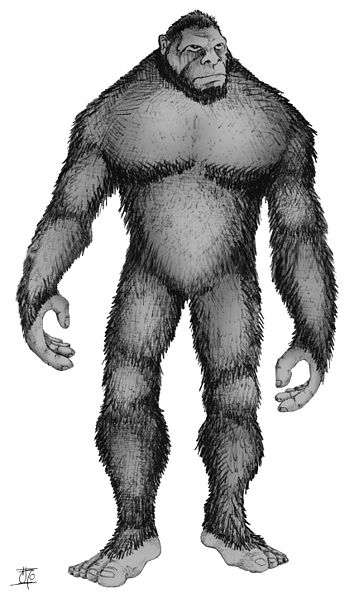 The honka is sometimes referred to as “Hairy Man.” More specifically, it is a hairy, man-eating ogre in Creek mythology. Another Creek term for this creature is kolowa, a term originally used by the Crow people but adopted by the Creeks after their forced removal to Oklahoma. Some recent Creek storytellers have translated kolowa as “gorilla.”
In many ways, the honka or kolowa is the Creeks’ answer to “Bigfoot”—although it is questionable whether Native Americans ever had a “Bigfoot legend” such as white Americans would conceive it.
Honkas are malicious creatures. One story reported by Michelle Smith in Legends, Lore and True Tales of the Chattahoochee (The History Press, 2013) describes how a female kolowa killed and ate the wife of a hunter—and other members of his village—while the hunter was away from home.
Uncanny Georgia: Sharp Ears
Here’s another creature described in Bill Grantham’s Creation Myths and Legends of the Creek Indians (University Press of Florida, 2002):
Sharp Ears were usually seen in pairs and never traveled east or west. Seen especially near the sources of small streams, they had sharp noses, bushy tails, and globular feet. The Oklahoma Seminoles called these Fire Dogs. Lena states that these creatures were about a foot tall and had ears, and that the male and female always traveled together. (36)
The Muskogee word for these creatures is hvcko fvske, which Grantham renders as håtcko fåski. By whatever spelling, the approximate pronunciation is “hutch-ko fuss-kee.”
Uncanny Georgia: Like-a-Bear
The nokos oma (“like-a-bear”) is an obscure creature from Muskogee folklore. It is described in Bill Grantham’s Creation Myths and Legends of the Creek Indians (University Press of Florida, 2002):
Like-a-Bear was about the size of an ordinary black bear but always carried its head near the earth and had immense tusks that crossed each other. The Oklahoma Seminoles described this being as about two feet tall and smelling worse than a skunk. (36)
So, apparently you don’t want to startle it. Either it’s as big as a regular bear and it may well gore you with its tusks, or it’s tiny but stinks to high heaven.
Kassan Warrad: Defining Human
Kassan Warrad’s latest post at Mythic Scribes seeks to ground fantasy races (orcs, elves, etc.) in real-world evolutionary framework. This is ground I covered in fleshing out the various groups depicted in Into the Wonder—and for the same reasons Kassan suggests. Namely, to achieve a greater level of lifelikeness:
A systematic approach to defining your races will help shape the underpinnings of your world. How are the races related to one another? Do they share a common ancestor? Can they interbreed and produce viable, fertile offspring?
These questions help define your races’ distinct sociopolitical boundaries. The world will feel more authentic, and many readers will appreciate the invested thought.
At the bottom of all of this is the issue of relatability. Do members of these groups have the same sorts of goals, aspirations, and emotions as the readers (who are all, at least in theory, human)?
The question of who counts as human is a theme underlying my third novel, Oak, Ash, and Thorn, which will be coming in February 2016.
Sunday Inspiration: Dignity
A person’s a person, no matter how small.
—Dr. Seuss
Uncanny Georgia: The Georgia Mothman
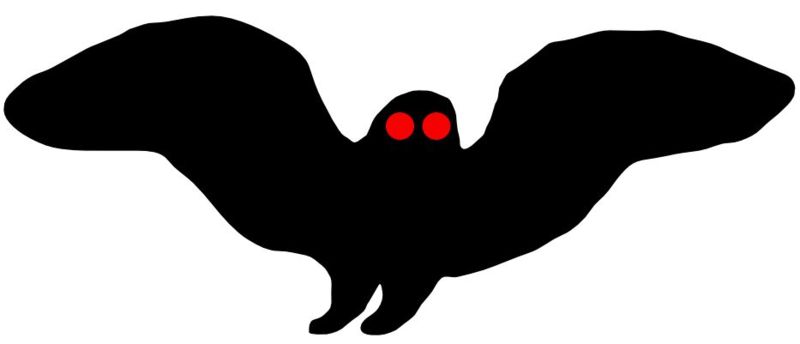 The Mothman, a purported giant winged humanoid, is associated with a string of sightings in West Virginia in the 1960s. A similar creature, however, was sighted in recent years in north Georgia. A woman who wished to remain anonymous reported an encounter on an old country road. She says,
Suddenly, something flew in front of the car and hit the windshield with enough size and force that it totally mangled the grill and hood. I immediately stopped the car. I heard what sounded like wings flapping on the roof, but then something rolled down the back window onto the trunk then eventually on to the road. I thought I killed whatever it was. A woman in a truck had pulled up from behind and said she saw the thing hit the road. She said that it’s eyes were glaring bright red. As we looked more closely at this thing it resembled a man with large bat-like wings….
This thing had the body of a well-built man. It had no feathers but charcoal gray skin like that of a bat with some hair on the shoulders and around the eyes and legs. When it spread it’s wings, it had the span of 12 foot or more. I estimate it was about 8 foot tall. It had no head however, just the eyes embedded on the shoulders that had brows. I didn’t noticed a mouth or nose.
Someone else in northern Georgia apparently had a similar encounter and managed to snap a photo of a glowing, winged creature. (Though it’s probably a fake.)
Ten Commandments for Epic Fantasy Writing
If you’re a budding Epic Fantasy author, you’ve likely read quite a lot of advice about how your novel should start. Having read thousands of submissions and more than my fair share of published novels, I’d like to share with you ten openings that should be avoided. So here, in my opinion, is how not to do it…
-
Make sure you get all that pesky world-building out of the way up front. How can I ever enjoy your story unless I know everything about the world? What is that clasp on the archer’s tunic made from? Where and when did she get it and how much did it cost? If you want you can put all this in a lengthy prologue, but we need to know this stuff.
-
Is it raining? Describing the weather is such an dynamic way to start your novel. Nothing says ‘Epic Fantasy’ like a light breeze. We need a least three pages before we can even think about those characters.
-
The Family History. An extension of 1) really. Ok, so this guy is running for his life. But when was his grandmother born? Quick, I can’t possibly invest in this until you’re told me. That leads us to…
-
Introduce all of your characters straightaway. Fortunately readers all have photographic memories, so cram in as many names as you can in the first few pages. Better still, give them names that are impossible to pronounce like Horguur’thzogh and Ek’mazikav’tx so they will really stick in the mind.
-
Describe absolutely everything. ‘She deftly flicked the thin strand of her glossy raven hair from her cold green eyes and purposefully and steadily raised the bow of ancient, dark yew and meticulously…’ Whassat? Sorry, I think I nodded off for a second there.
-
And it was all a dream. A great way to make your world seem tedious to put a vivid dream right up front and get the reader to invest in it. Then wake your protagonist up, and you can rub it in the readers’ faces that it was all pretend and simultaneously make the ‘real’ world seem really boring. Result.
-
Waking up. Or you can skip the dream and just open with someone waking up. Every day starts with someone getting up, so why not every novel? Then they can have breakfast, which is one of the mainstays of Epic Fantasy.
-
Try hiding your info dump in dialogue. ‘My brother Rak, you know how our father, the Emperor, sent us on this quest six moons ago? Well, as we heard those outlanders – our sworn enemies – near our camp last night, if your twisted ankle is up to it, perhaps it is time to lay down the swords that once belonged to our grandfather – a famous hero of his time – and take the long road home through the mountains.’ Smooth, huh? This works well with internal monologues, too.
-
Use plenty of metaphors. Although you’re writing a Fantasy novel and everything is up for grabs in the first chapter, don’t be afraid of using metaphors from the off. Of course the beast isn’t literally a hundred feet tall or the protagonist really has eyes that shine like blue fire on a dark night. It’s obvious. Your readers are smart; they’ll figure it out eventually.
-
The epic battle. They say you should open with a bang, so why not a twenty-page action sequence? Who cares that we don’t know who anyone is, aren’t bothered if they live or die, where they are, or what’s at stake! Fight! Fight! Fight!
Uncanny Georgia: The Ishkitini
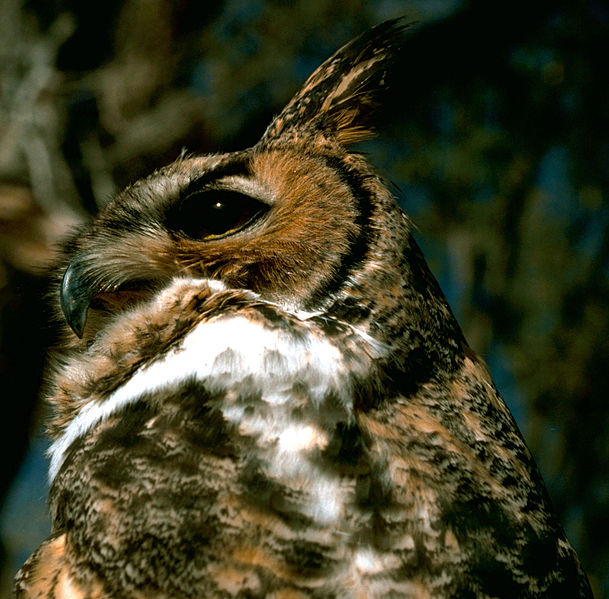 The origins of the legend of the ishkitini are hard to pin down. Apparently, it was first described in Choctaw legend, but it was also known among the Creeks and Seminoles. It is a given that the Creeks and related peoples of Georgia would have believed in such creatures. Ishtikini, stikini, stigini, etc. are all variations of the same word.
Ishkitinis are malevolent shape-shifters. Although they might take on the shape of any sort of wild predator—wolves, coyotes, bears, etc.—they strongly favor owls. In fact, their name means “horned owl.”
These creatures are classified as “witches.” In much Native American lore, a “witch” is not a human practitioner of magic but rather an inhuman monster that is able to pass as human. By day, ishkitinis look like ordinary humans. By night, however, they prey upon their neighbors. The Seminole version of the legend is the most disgusting. According to this version, ishkitinis change their shape by vomitting up their souls—along with their internal organs.
In some stories, mentioning these creatures by name puts one at risk of becoming one. Therefore, stories about ishkitinis are only told by certain medicine men and women. In other communities, however, they are more of a bogeyman figure casually discussed to frighten children.
An ishkitini appears in The Devil’s Due, though he is never identified as such. One character describes him as “a pooka with a bad attitude.”

