
Recent Comments


Sunday Inspiration: Kindness
No act of kindness, no matter how small, is ever wasted.
—Aesop
The Language of Birds?
Silbo Gomero is a method of transposing the sounds of spoken Spanish into whistles. Arika Okrent at mental_floss explains:
The human voice can only carry so far, but a whistle can travel for miles. In the mountains and ravines of La Gomera, in the Canary Islands, a language of whistles has been used for centuries to transmit long distance messages with amazing accuracy.
The article goes on to explain that there are other whistle-languages known in other parts of the world.
In Ghanaian folklore, the mmoatia communicate by means of a whistling language, and whistling in the forest is a sure way to get their attention.
In the world of Taylor Smart, many fae are familiar with the language of birds—a detail I added in honor of The Hobbit, although Tolkien no doubt was inspired by Germanic mythology, where this ability comes up from time to time.
It would definitely be a handy skill to have, especially since you can rarely get a cell phone signal in faery-land.
Sunday Inspiration: Good Thoughts
If you have good thoughts they will shine out of your face like sunbeams and you will always look lovely.
—Roald Dahl
Review: Conjure Woman’s Cat
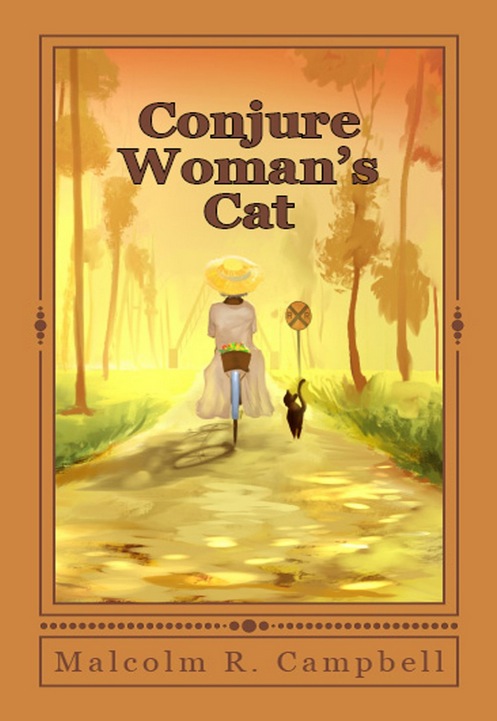 Conjure Woman’s Cat by Malcolm R. Campbell explores the life of a close-knit African American community in the 1950s Florida panhandle through the eyes of Lena, the feline assistant to Eulalie, a “conjure woman” or folk-healer and magician. When an act of injustice provokes Eulalie to use her mystical powers to settle the score, it threatens to expose her own closely held secrets.
The novella’s tone and themes are similar in many ways to To Kill a Mockingbird, but with a heavy dose of magical realism. The story is engaging, with complex and believable characters, but I found it at least as fascinating as an account of traditional Southern black culture. There is even a glossary at the end of folk magic, Florida history, and mid-twentieth century blues performers. The glossary is quite interesting, but not at all necessary for enjoying the story.
Conjure Woman’s Cat deals with mature themes, but does so with discretion and sensitivity. There is a bit of rough language, but nothing middle schoolers old enough to be assigned To Kill a Mockingbird haven’t heard before.
Sunday Inspiration: Perspective
I like friends who have independent minds because they tend to make you see problems from all angles.
—Nelson Mandela
The Fairy Flag of Clan MacLeod
Some light reading for your Thursday:
Many, many years ago, the Chief of Clan MacLeod was a handsome, intelligent man, and all the young ladies in the area were very attracted to him, but none suited his fancy.
One day, he met a fairy princess, a bean sidhe, one of the Shining Folk. Like all the other females he met, she fell madly in love with him, and he with her….
Sunday Inspiration: An Educated Mind
It is the mark of an educated mind to be able to entertain a thought without accepting it.
—Aristotle
A History of the Fae
Leo Elijah Cristea has posted the final installment of his series on the fae. (Links to all four parts here.) This has been a very informative series looking at the legends and myths surrounding the Fair Folk, and I heartily commend it.
In this final part of our exploration of the fae, it seems appropriate to take a look at not only the varied and expansive wealth of literature and that features fae, or any recognisable incarnation of them, but also a more comprehensive look at their time line. We’ve briefly explored the evolution of the fae, from Irish folklore, through to Shakespeare’s romantic depictions, and to their modern day Disney or urban fantasy cousins, but the long and fluid history of the fae makes it difficult to succinctly follow. As such, if we head as far back as a pre-Christian time, indeed touching on the relevance of Pagan faeries and early Greco-Roman fae we start to see that two things are true:
You’ll just have to click through to see what those two things are. 🙂
Sunday Inspiration: Free Will
Why, then, did God give them free will? Because free will, though it makes evil possible, is also the only thing that makes possible any love or goodness or joy worth having.
—C. S. Lewis
 Darrell J. Pursiful